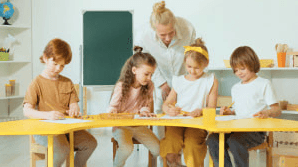
Preschool Education: Its Importance and Effects
Discover why preschool education matters and how early learning shapes a child’s cognitive, social, and emotional development
Preschool education represents one of the most important early experiences in a child's life, laying the foundation for lifelong learning, behavior, and emotional well-being. During the ages of three to five, children undergo rapid brain development, forming neural connections that influence how they think, interact, communicate, and understand the world. A high-quality preschool environment nurtures these developments by providing structured learning experiences, opportunities for exploration, social interaction, and emotional growth.
This course explores the significance of preschool education, the core elements that make it effective, and the lasting effects it has on children. Whether you are a parent, teacher, caregiver, or student of psychology or education, this course will deepen your understanding of why early childhood education is not only beneficial but essential.
1. The Importance of Preschool Education
Preschool is more than a place where children learn shapes, numbers, or colors. It is a dynamic environment that fosters curiosity, independence, cooperation, and problem-solving. Research consistently shows that children who attend preschool demonstrate better cognitive skills, stronger language abilities, and more advanced social behavior compared to children who do not.
One of the primary purposes of preschool is to create readiness for formal schooling. Children learn to follow routines, listen to instructions, work in groups, and manage their emotions—all skills necessary for success in kindergarten and beyond. At this stage, children absorb knowledge rapidly, making preschool a crucial window for introducing fundamental concepts in literacy, numeracy, and communication.
2. Cognitive Development in Preschool
Cognitive development refers to how children think, understand, learn, and problem-solve. In preschool, children develop memory, attention span, and early reasoning skills through structured activities such as puzzles, storytelling, block building, and guided play.
Preschool classrooms encourage children to ask questions, explore materials, make predictions, and find solutions. These experiences stimulate brain growth and create pathways for higher-level thinking. Activities like sorting objects, identifying patterns, and following sequences contribute directly to early mathematical understanding.