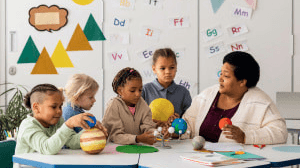
STEM Education In Early Childhood Settings
Learn how to introduce STEM in early childhood through play-based, hands-on learning experiences.
STEM education in early childhood lays the foundation for curiosity, critical thinking, and lifelong learning. This course explores how science, technology, engineering, and mathematics can be introduced in developmentally appropriate ways within early childhood settings.
The course begins by explaining why early exposure to STEM is important for cognitive development and problem-solving skills. Learners will understand how young children naturally explore, question, and experiment with the world around them, making early childhood an ideal time to introduce STEM concepts.
You will explore practical strategies for integrating STEM into everyday activities through play-based and inquiry-based learning. The course provides examples of simple experiments, building challenges, counting activities, and technology exploration suitable for preschool and early primary learners.
This course emphasizes hands-on experiences that encourage observation, prediction, testing, and reflection. Learners will discover how to create a supportive environment where children feel confident asking questions and exploring solutions.
Inclusion and accessibility are also key themes. The course discusses how to adapt STEM activities to meet diverse learning needs and ensure equal participation. Educators and parents will learn how to foster collaboration, communication, and creativity through group STEM activities.
By the end of this course, learners will have practical tools and strategies to implement STEM education in early childhood settings confidently. This course empowers educators and caregivers to nurture young learners’ natural curiosity and prepare them for future academic success.